













Don't know when to change your car to summer tires and how to choose the right tires for the 2026 season? We have prepared a practical guide to help you choose safe summer tires for 2026 and avoid the most common mistakes. Correct changing car tires after winter has a major impact on safety, fuel consumption and tire life. We also looked at a comparison of the best tires.
When to change car tyres after winter
The general rule is to switch to summer tires as soon as possible., when temperatures are maintained for a long time above 7-8 °C. In Czech conditions, the ideal term is beginning of April, according to the current weather. If the forecast does not indicate morning frost or snowfall, it is time to make an appointment with a tire service. Do not underestimate the need to change your wheels and leave the car to the experts. Tires are among the most important elements of safe driving.
Why not drive on winter tires in the summer
Many drivers say to themselves: „I can use winter tires even in summer.“ This is a mistake. At temperatures above 20 °C, the braking distance of winter tires can be up to several meters longer than that of summer tires. Winter tires are made of a softer compound that works great in cold weather, but as soon as they warm up, their properties deteriorate.
In addition, it is true that
- Winter tires wear out quickly in summer
- increase noise
- fuel consumption increases
- the car's stability in corners deteriorates
What parameters to look for in summer tires
Selection tires It depends on your driving style, car type and budget. When buying, focus on these parameters:
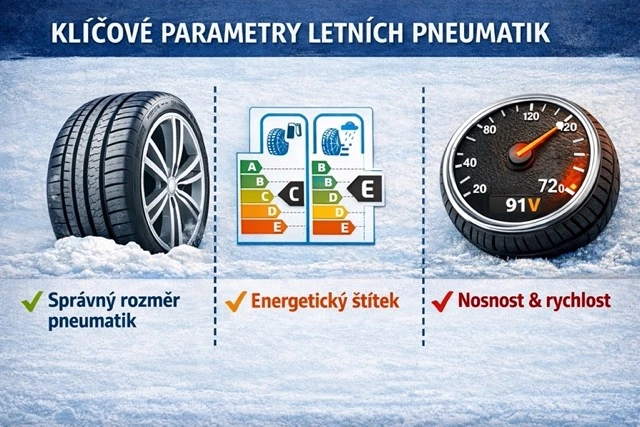
1. Correct tire size
You can find the size:
- in the technical certificate
- on the sidewall of existing tires
- on the label on the driver's door pillar
Never choose a size other than that allowed by the manufacturer.
2. Tire energy label
Every new summer tire has its own energy label, which works similarly to a refrigerator or washing machine. It contains three important pieces of information: fuel efficiency, wet grip and external noise.
Wet grip, in Czech: Wet grip
This is what affects braking distance on wet roads. You will find this marking in the range A to E, where a tyre with a rating of A stops in the wet sooner than a tire with a rating C or E. The difference between A and E can easily be up to 15–18 meters when braking from 80 km/h. For safe driving, we recommend class A and B.
Fuel efficiency, in Czech: Fuel efficiency
Fuel efficiency on the label indicated by letters ranging from A to E.
In fact, the manufacturer says how much the tire "brakes" the car when driving. Every tire offers resistance when driving, in tires this is called rolling resistance.
The greater the resistance, the more the engine has to work and the more fuel it consumes. A tire marked with the letter A has less resistance and lower consumption than a tire marked with the letter E. For safe driving, we recommend A and B, possibly a compromise C.
External rolling noise, in Czech: External noise
The energy label also shows the external noise level, which is given in decibels (dB) and is accompanied by a class A–C. This indicates how much the tyre can be heard from outside when driving. The lower the dB number and the better the class A, the quieter the tire. Most drivers hardly notice the differences in normal driving, so it is more of a comfort feature than a crucial safety parameter.
In practice, wet grip is most important (ideally A or B) and then fuel efficiency (A to C). If a tire has wet grip A and fuel efficiency C, it is safe choice.
3. Load capacity and speed index
On every tire you will find two important values at the end of the size. The load index tells you how much weight a tire can carry, for example 91V, when the number 91 is the load capacity of the tire. The letter V is the speed index and determines the maximum safe speed for which the tire is approved. These values must be the same as or higher than those stated in your car's registration document. Choosing lower values can be dangerous.
How long do summer tires last?
The average lifespan is 3–5 seasons, it depends on:
- mileage
- driving style
- correct inflation
- wheel geometry
The minimum legal tread depth is 1.6 mm, but for safety reasons it is recommended to replace at 3 mm. The difference between 3 mm and 1.6 mm can easily be several meters of braking distance on wet roads. Correctly selected summer tires It will provide you with shorter braking distances, lower fuel consumption and safer driving throughout the season.
If in addition you are choosing a used car, the condition of the tires and the overall technical condition of the car are crucial. When buying a used car, it pays to have the car professionally inspected, not only for the tires, but also for the brakes, chassis or any hidden defects. Here in AUTOMATO.cz to you we will check a used car before buying it. This ensures that you are buying a safe and reliable car.
✅ Change shoes when temperatures consistently exceed 7°C
✅ Don't drive on winter tires in the summer
✅ Monitor wet grip and brand quality
✅ Keep the correct size
✅ Check pressure and geometry
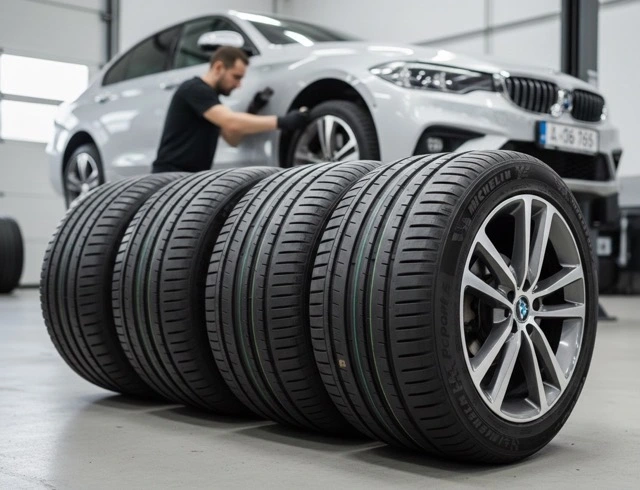
Best summer tires for 2026 according to the results of independent tests and driver ratings in the price range of 2,300–3,000+ CZK per piece:
- Continental SportContact 7 – excellent braking on dry and wet surfaces, stable handling
- Michelin Pilot Sport 5 – balanced performance and long service life
- Goodyear Eagle F1 Asymmetric 6 – safe and manageable tire
Common summer tires for 2026 in the lower price range of 1,200–1,900 CZK per piece we recommend:
- Barum Bravuris 5HM – solid performance at a low price, a good choice for everyday riding
- Hankook Ventus Prime4 K135 – comfortable tire with low rolling resistance and good durability
- Kleber Dynaxer HP3 – balanced tires with safe properties on both dry and wet roads